
Is your AI increasing your people's capacity, or growing their capability?
If you have brought AI into your organisation, or are about to, you are probably in one of two groups. The first is using it to do the same work with fewer people, a cost play, margin over everything. The trouble is that any competitor can make the same move, which turns it into a pricing war, and those tend to be races to the bottom with no prize for winning. The second, where most thoughtful leaders I speak to are now sitting, is using it to move people off the low, repetitive work so they can focus on the thinking work. The ideas, the judgement, the innovation. The evolution of the business rather than the shrinking of it.
I read a post by Amy Fane Hervey last week who noted "Installing the tech is not the same as redesigning around it." I agree completely. Bolting AI onto the organisation as it stands changes very little, and the organisations seeing real returns are the ones redesigning the work around it.
But it leaves a question standing, and it is the more important one. Redesign what?
Here is the question I would ask before any of the usual ones about tools and pilots and workflows.
Is your AI deployment increasing your people's capacity, or growing their capability?
They sound like the same thing. They are not, and almost everything that matters sits in the gap between them. Redesigning a process increases capacity. It finds the parts a machine can carry and hands people back the hours, and there is genuine value in that.
But underneath it sits an assumption that is rarely said out loud: that time was the thing standing between your people and better work. Free the capacity, and the capability will rise on its own.
It won't. A person does not reason better because their afternoon is emptier.
The largest blocker to capability in knowledge work is not capacity. It is what your people have to think with.
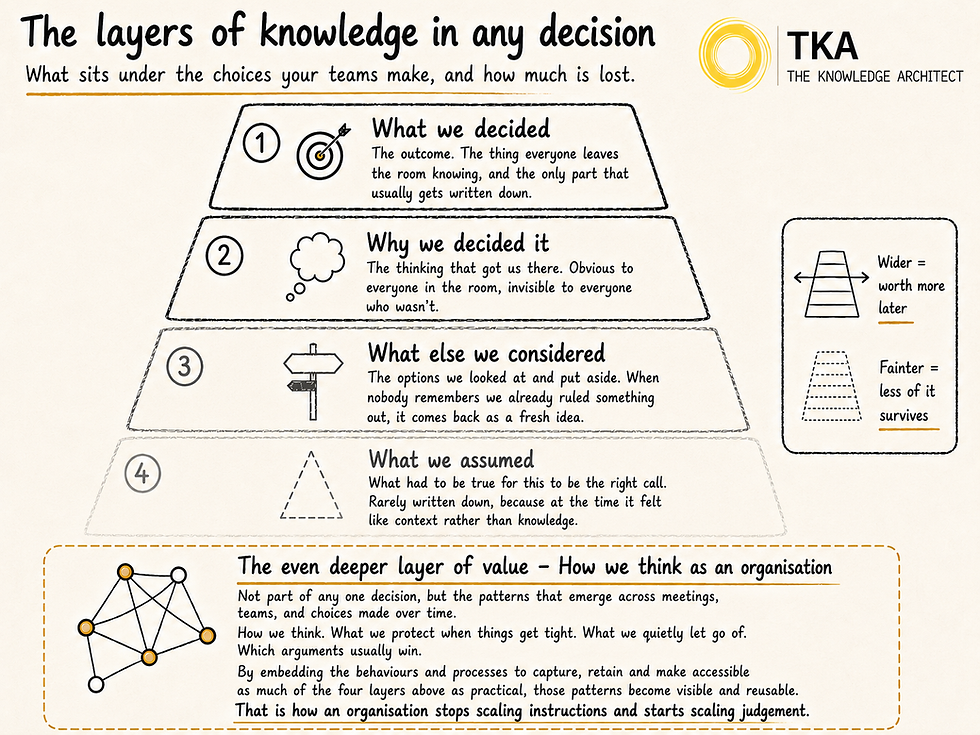
Think about what performing well in knowledge work actually rests on. Certainty about what needs to be done, because most stress at work comes not from the volume of it but from the uncertainty around it. Not starting from zero, being able to build on what you have done before, and on what others worked out before you. Knowing which approaches the team has already settled on and why. Having the past learnings of the organisation within reach rather than in someone's head. Being able to see your own growth, so a hard week leaves a trace you can point to instead of dissolving behind you.
None of that is given by an emptier calendar. All of it is given by the knowledge around you being structured, trustworthy, and reachable. And in most organisations it is none of those things. It lives in inboxes, in half-remembered conversations, in the heads of whoever happened to be in the room. A person reasoning from that is reasoning from almost nothing, however many hours you free up for them. The deployment aimed at efficiency, and forgot about effectiveness.
A quick side note, there is a tempting shortcut here, and a wave of new tools selling it: point AI at the mess, graph everything, call the result knowledge. But the mess is not the knowledge. Mining everything gives you a searchable version of the same chaos. The tools matter, and this era's are remarkably good at extraction. The difference is whether a design sits behind them, knowing what must exist, what earns a place, and what is missing entirely, the reasoning never written down anywhere. The tool does the reaching. The design decides what is worth keeping, and what can be trusted.
Now imagine what the deliberate version makes possible.
Your newest team member asks for a handover built from everything the team has actually learned, and gets one in minutes.
You check a piece of work against the accumulated reasoning of the organisation before it goes out, not against whatever you could find.
You run analysis not just on data but on choices made, insights already developed, the reasoning behind paths considered and set aside.
And you can do all of it in the room, with your team, the AI sitting in the conversation like a well-read colleague who was present for every decision the organisation ever made.
That is what growing capability looks like in this era. Your people, paired with this generation of tools, working from more than they could ever hold alone. Not the tool doing the thinking, and not the person doing it unaided. The two together, standing on a foundation built for both.
In the past, investing in capability mostly meant training. What is different now is that the tooling finally exists to go much further, but only on one condition: the knowledge it draws from has to be deliberately structured, governed, and trusted.
That foundation is a discipline in its own right. Knowledge architecture. Designing the environment where what your organisation knows becomes reliable, findable, and reusable, by your people and by the AI working alongside them.
And here is what it does to the person, which is the part that gets missed. When what you know lives only in your own head, you are your knowledge. You rise and fall with what you can personally hold, and sharing it feels like giving your value away. In a well-built environment that logic inverts. Your thinking, captured, becomes the source others reason from, which is a far stronger position than being the person who happens to remember. And as the tools improve, the skill that keeps you ahead of them is not operating them, it is feeding them well-grounded material and judging what they hand back. You stop being your knowledge and start operating it. That is a different way to be good at your job, and a steadier one.
There is a return in this for the organisation, of course, and it is the kind worth having. Capability, once grown, is an asset you own. It does not renew annually, it is not priced by a vendor, and it does not walk out the door with any single person, because it lives in the foundation and in the people together.
But the reason to do it was never really the return. It is what happens to the people.
Give someone more room to think and you have given them time. Give them more to think with, and you have changed what they are able to do.
That is the redesign worth doing.


Comments