
The Layers of Knowledge in any Decision
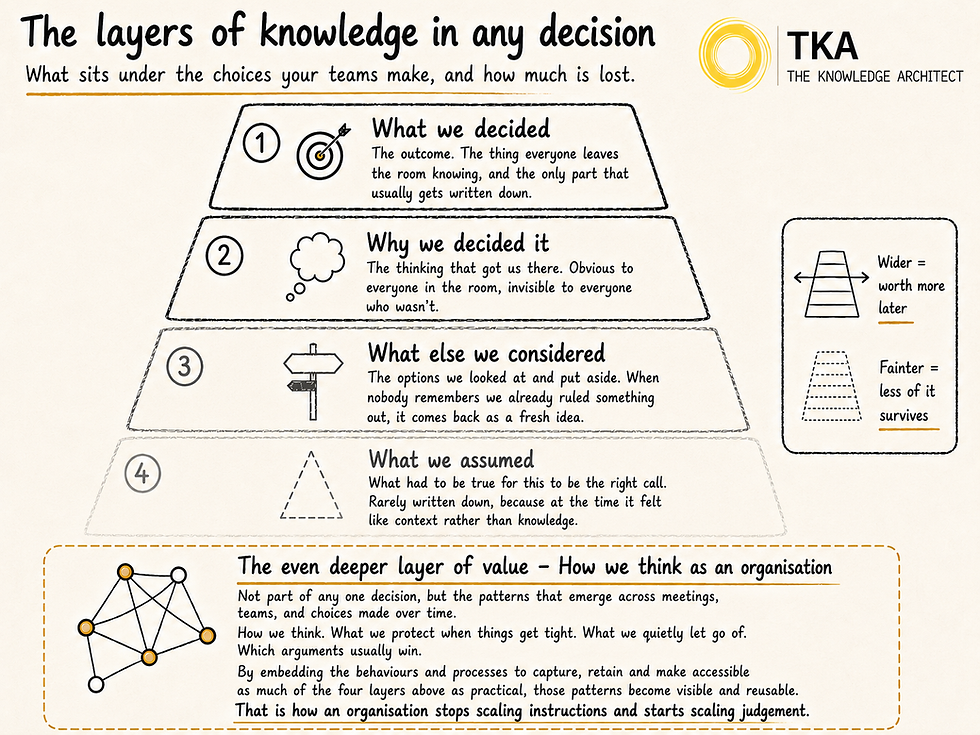
Your teams make choices every day. Some small, some not. Together, those choices shape how the business moves, what it prioritises, and what it becomes capable of.
People leave the room clear on what was agreed, at least, we hope. Someone may write down the decision, usually in a summary or action list. Almost everything beneath it stays in the heads of whoever was there.
So the question worth asking is a simple one: of everything a decision produces, what do you actually keep, and what do you lose?
The image sets out the four layers that sit beneath a decision. The important part is what happens when only the top one survives.
Next week, someone executing on the decision hits a scenario nobody discussed. They have the instruction but not the intent, so they guess. The work drifts from what was agreed and nobody notices, because the person who could tell the difference is not in that conversation.
Next quarter, an option that was properly examined and rejected comes back as a new idea. Nobody remembers it was ruled out, or why. The business spends weeks rediscovering what it already knew.
Later in the year, conditions change. Someone asks whether the decision still holds. Nobody can answer, because nobody remembers what it depended on. The choice is to leave it standing and hope, or rebuild the entire argument from scratch under pressure.
And when people leave, all of it goes at once. Not the decision, but everything underneath it.
The loss is easy to miss, like a slow puncture. But it shows up later: execution slows, old debates return, and the business cannot explain its own position when someone asks.
There is one more very valuable layer, and it belongs to no single decision or meeting. Capture these layers consistently across enough decisions, meetings and teams, and something begins to appear that nobody can see on their own: how the organisation actually thinks. What it protects when things get tight. What it quietly abandons. Which arguments usually win.
These layers can be captured, retained and made usable by your people and by the AI working alongside them.
If your organisation is keeping the decisions but losing the knowledge beneath them, message me.


Comments